
By Carol Ochs
In every generation, Jews have understood the significance of the Torah in their lives. We have studied, written, and taught about the meaning of Torah and its relevance to contemporary circumstances. With the publication of The Torah: A Women’s Commentary in 2007, the teachings of women scholars and Jewish professionals on the significance of Torah in their lives is now available in a scholarly compendium. The “Contemporary Reflections” section in The Torah: A Women’s Commentary, “enable us to hear women’s voices that reckon with divine revelation… each essay shows the significance of Torah as a record of God’s revelation to Israel: it is a repository of Jewish memory, however incomplete, from which we, as individuals and as members of contemporary Jewish communities, can attempt to hear and understand the voice of God.” (Ellen Umansky, “Women and Contemporary Reflection,” The Torah: A Women’s Commentary, page ix)
Today’s Ten Minutes of Torah is excerpted from The Torah: A Women’s Commentary, pages 55-56.
Genesis begins with God's creation of the world by word alone: God said, "Let there be light!" (1:3). At the end of Genesis 1, God surveyed all that [God] had made, and look – it was very good! With language God created the world, separated the waters above from the waters below, named, judged, and expressed great satisfaction with the results. But by the end of parashat B'reishit, we read that Adonai, saw how great was the wickedness of human beings . . . So Adonai, thought: “I will wipe the humans whom I created from off the face of the earth” (6:5-7).
In parashat Noach, what sin had the people committed to warrant the Flood? The fact that so many different answers have been offered suggests that there is no clear answer. Some interpreters say that the wrongdoing was miscegenation: the interbreeding between the sons of God and the daughters of mankind (6:1-4). Others in traditional sources postulate that it was the sin of refusing to have children – indeed, even Noah waited until he was 500 years old to have his first child.
For all the various theories about the precise nature of the sin, it is clear that the Flood's essential purpose was to cleanse Creation of the flaw that led to its corruption. And yet, from the time of the Ark's landing on dry land, God demonstrates an awareness that some essential flaw persists. God says: Never again will I bring doom upon the world on account of what people do, though the human mind inclines to evil from youth onward (8:21). Why does the human mind incline to evil? What is the flaw in the human mind? While the questions are not explicitly answered, we can nevertheless find answers in our tradition.
Many commentators have criticized Noah for not challenging God about the planned destruction, as Abraham later does when God reveals the plan to destroy Sodom and Gomorrah (18:17-33). Readers over the ages have been puzzled by Noah's silence. But his silence is precisely the point. Nearly the entire portion of Noach is filled with God's speech and Noah's actions – but not words. From his building the ark through the entire Flood, Noah utters not a single word. When Noah finally speaks after being awakened from his wine (9:24), his words disclose the problem: he understood what his youngest son had done to him, so he said “Damned be Canaan! To his brothers he shall be the basest of slaves!” (9:24- 25).
So Noah's first words neither praise God, nor express gratitude, nor ask for help, nor proclaim justice. Instead, he uses language to curse and to set up the differentiated love that will plague all the offspring of Genesis – from Ishmael and Isaac to Esau and Jacob and to Joseph and his brothers. By “differentiated love” I mean love that is given to one person and withheld from another.
Noah's first words show what might be an essential flaw in creation, leading to destruction in this parashah. As we read in Proverbs 18:21, death and life are in the power of the tongue. We have already seen the creative power of language in Genesis 1. Now it becomes clear that one sin causing the Flood was the abuse of language. In a way, we have always known that, as the Confession for the Day of Atonement lists many forms of language: idle talk, offensive speech, foolish talk, slander, passing judgment, plotting, talebearing, and swearing falsely. Each of these offenses involves some abuse of language.
In parashat Noach, the inherent flaw is made clear. Noah's words form a curse; moreover, even when he comes to bless (9:27), he does so comparatively, blessing one son at the expense of another son's son, relegating his grandson Canaan to the role of slave. But love should not be comparative, quantifiable, or conditional.
God acknowledges the power of human language in the very next story, the episode of the Tower of Babel (Genesis 11). This time God, in order to restrain the people who are reaching out to heaven, confuses the language. God is thus undermining their capacity to use language in a destructive fashion (11:1- 6).
From Noah's words and the people's words when they attempt to build their tower, we learn that the language that survives the devastation of the Flood is that of differentiated love, competition, hatred, cursing, and revenge across generations. God's action at Babel is an attempt to heal the flaw of the sin at Babel by multiplying languages: perhaps somewhere among the new tongues would emerge a vision of reality that transcends the destructive, condemning words carried forward in the ark.
Our own experience verifies the lesson of the sin of the Flood. We know how language can kill. We have seen the medical charts on which a doctor has scribbled “untreatable,” thereby sealing a patient's fate. We have labeled a plant in our garden a “weed,” thus sealing its fate.
Silence, then, might be a virtue. During the long days of the Flood and its aftermath, Noah did well, being silent. His silence reminds us of the better part of Job's comforters who initially sat with him on the ground seven days and seven nights. None spoke a word to him for they saw how very great was his suffering (Job 2:13). Once they began to speak, though, their words brought only discomfort; and finally God rebuked them: for you have not spoken the truth about Me as did My servant Job (42:7).
What lessons may we draw from this juxtaposition of silence and language? Is human speech invariably destructive? Where can we find the language that blesses, heals, and even creates? Again, the model is within this parashah, when God responds.
God restricts divine power, saying: Never again will I bring doom upon the world on account of what people do (Genesis 8:21); God restores blessings: God then blessed Noah and his sons saying to them, “Be fruitful and multiply and fill the earth” (9:1) and God enters into covenant with all living creatures: I am going to establish My covenant with you and your descendants after you, and with every living being in your care (9:9-10).
God's words and actions in the aftermath of destruction show us how we can use language to repair relationships, instruct others, forgive, and bless.
Dr. Carol Ochs was Director of Graduate Studies and Adjunct Professor of Jewish Religious Thought at Hebrew Union College-Jewish Institute of Religion (New York) prior to her retirement in 2009, where she taught and provided spiritual guidance for rabbinic students and Doctor of Ministry students. She holds a Ph.D. in philosophy from Brandeis University and is professor emerita at Simmons College, Boston. She is the author of eight books, the most recent of which is Reaching Godward: Voices from Spiritual Guidance (2003). Among her other books are Our Lives as Torah (2001); Jewish Spiritual Guidance (1997, with Kerry Olizky); and Women and Spirituality (1996).
The WRJ Ten Minutes of Torah series is sponsored by the Blumstein Family Fund and by Sandi and Mike Firsel and Temple Chai Sisterhood.
Related Posts
Image
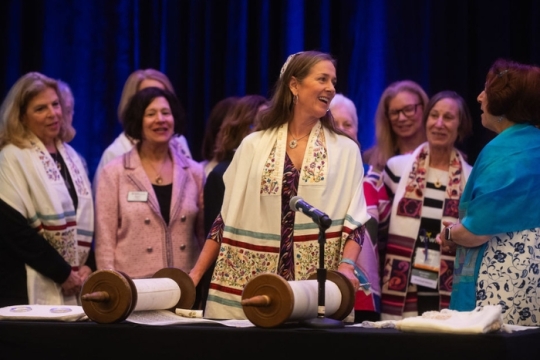
Gather Round for the Global Women's Torah Circle!
Do you have an interest in Jewish spirituality, Torah study, and feminism? Are you interested in meeting and connecting with other Reform/Progressive women from around the world? Women of Reform Judaism, in partnership with the World Union for Progressive Judaism, is excited to announce, “Voices &
Inclusive Voices
by Rabbi Rabbi Loren Filson Lapidus On Tuesday, July 26th, as Hillary Clinton officially became the first woman to be nominated for president by a major U.S. political party, I tried to explain to my five year-old daughter the import of the moment. This was not the first time I have shared with her the legacy and history she carries as a girl, and one day a woman, in this world. “Women couldn’t always wear pants,” “Women couldn’t always vote,” and “Women couldn’t always be rabbis”—just a few of the things my daughter, and I, have the opportunity to do through the pioneering of the women who came before. When I was younger, I did not fully appreciate this legacy. After all, I took for granted that as a woman I would have opportunities equal to any man. I was then exposed to the realization, little by little, that I have a woman’s voice in a world that is not always ready to listen. As a woman, a daughter, a sister, a wife and now a mother, my worldview is shaped by these roles and my identity as a female. It is only in recent years that I have embraced my role as “woman rabbi” and the opportunities to raise the feminine voice—my voice—with pride and strength.
Leading Torah Study: Framing the Message
By Rabbi Jeremy Weisblatt What does it mean to lead a Torah study? When we sit with congregants, friends, are guests in different communities, what is it we are doing when we are given the honor to lead a Torah study? There is something quite amazing that we are doing – we are framing the message for this group. For that short moment in time that we are asked to lead, we are transmitting a concept, idea, ideal or moral teaching that we believe the group needs to hear. It is a truly powerful moment and the texts, commentaries, works that we bring to the table also convey the message of what our values are or what sources contribute to our very own understanding of the week’s parashah. For the Torah studies that I lead, I am indebted to a rabbi and teacher who taught me the important lens of gender to bring forth powerful lessons, messages and teachings.