In August 2025, WRJ announced a new leadership development program called ”Hineni: Leadership for a Changing World.” WRJ sought applicants for the inaugural cohort to build on mission-driven talents rooted in our Jewish values. To participate, North American Board members and WRJ District Board members interested in enhancing their leadership skills applied and completed a personal interview.
The kickoff for Hineni took place on the grounds of URJ Camp Coleman outside Atlanta, Georgia, where, except for sleeping, we spent all our time together. Similarly to a camp experience, after most of us met at the Atlanta airport, we shared a 2+ hour ride to the hills of Cleveland, Georgia.
The nonstop rain didn’t dampen our spirits (pun intended) but provided another point of connection and bonding. We arrived late Friday afternoon and were greeted by the dynamic trio of fredi Bleeker Franks, Blair Marks, and Susan Bass, who were instrumental in creating this program and who guided us through the first leg our Hineni journey. Sadly, Madelyn Katz could not join us for this first gathering.
After settling into our rooms, we gathered back at the dining hall, where we would spend the bulk of our time due to the weather, for schmoozing and to enjoy Shabbat dinner. While the menu from a local BBQ joint was not quite traditional, we lit candles, said the blessings, and shared how we usually observe Shabbat. We then enjoyed the local fare, and at the meal’s end, we were ferried back to our rooms where, fortunately, there was a cozy lounge for some pre-bed games, including Mah Jongg (of course), Scrabble, and Bananagrams.
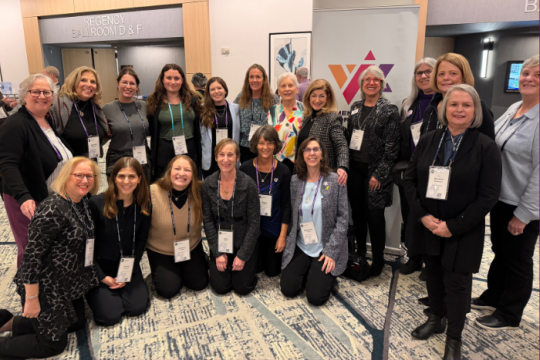
Our cohort is comprised of a small group of 13 women with diverse leadership experiences from involvement with local sisterhoods, districts, the North American Board, or committees we serve on in other capacities. Some of us have leadership experience from our professional lives as well.
What makes this program special is the smallness of the group. We were able to share our leadership experiences and, in a very safe space, discuss what worked and didn’t, provide each other with insights, and learn different techniques to contribute more effectively where we serve.
We awoke on Saturday to, unfortunately, more cold and rain. Our shuttle (which was Susan, Blair and Amy) arrived to take us back to the dining room, where we had breakfast and then began our work. Susan artfully led us through Torah study, discussing the Parashat for the week involving Moses, the burning bush, and the beginning of the book of Exodus. As we discussed the text, Susan helped us correlate Moses’ conversations with God about his role in confronting Pharaoh and how God had chosen him as a leader because God knew Moses could do it, though Moses himself had his doubts.
From Torah study, we moved on to several discussions and exercises, including each of us providing a metaphor for leadership. We then worked with each other to hone these metaphors, which provided great insight into how we viewed leadership based on our own experiences. These metaphors were hung around the dining hall where we could continue to see and refine them throughout the weekend.
Blair then introduced the concept and practice of relationship leadership, a business concept with mounds of material to back it up. This, I realized, is the secret (or not-so-secret) sauce of WRJ. Relationship leadership is the antithesis of hierarchical leadership; it allows everyone to access their leadership potential when the situation arises. Rabbi Hirsch discusses this in each episode of her podcast, “Just for This,” where she interviews women in leadership about what inspired them to step up and lead, just as Queen Esther did in the Purim story.
There is always so much to learn and share when attending a WRJ conference like the Fried Women’s Conference, Social Justice Conference, or District Conventions. This experience was unique in that it was truly intimate. We learned firsthand from some of WRJ’s most experienced leaders: fredi Bleeker Franks, Blair Marks, and Susan Bass, whose brainchild it was to offer this program that provides the tools so that when inspired, we too can declare “Hineni, here I am.” When we recognize others that might have the desire but not the confidence to step up as leaders, we can give them the support they need for success.
On Sunday morning, we were joined by WRJ CEO Rabbi Liz P.G. Hirsch, Andrea Gingold, VP of Leadership of WRJ, and Joanne Fried, lifetime board member and supporter of WRJ. They joined us for breakfast, and we shared our leadership metaphors with them. Rabbi Hirsch offered another view of the Parashat of Moses and its connection to leadership. While they weren’t with us for long, them taking the time to come and join our learning spoke volumes.
Being part of this program reinforced my understanding that, since its founding in 1913, the evolution of WRJ has been a direct result of its commitment to leadership at all levels. Our ability to meet the moment as the world changes is because of this commitment and ensures our ability to continue.
Our Aleph Cohort is just starting our leadership journey. We continue to meet remotely so we can keep learning together. To quote fredi Bleeker Franks in her post-event email with a link to pictures from the weekend, “You arrived as 13 separate people. You left a Kehillah Kedoshah—a holy community shaped by shared learning, listening, and care for one another.” She went on to say, “I am deeply grateful to have been part of it with you.” On behalf of the Aleph Cohort of Hineni, we are thankful to have spent this time together, sharing this journey and having the guidance of fredi, Blair, Susan, and Madelyn in absentia.
About the Author
Search
Related Posts
Creating a Successful YES Tea Event
"When Everything Looks Dark, You Are the Shard of Light"